Rebuilding the missing middle

why social infrastructure institutions matter for neighbourhood renewal
By Jack Strachan, Recurve Associate
Since the announcement of the UK’s Pride in Place programme – a £5 billion, decade-long investment intended to regenerate high streets, tackle deprivation and renew entire areas – neighbourhoods have entered a policy moment of their own.
From the Local Government Association’s Growth and Reform network and the Independent Commission on Neighbourhoods (ICON) to Local Trust’s Big Local and Place Matters, there is no shortage of excellent analysis of the structural conditions shaping neighbourhood decline. What remains far less developed however is how these diagnoses are translated into meaningful policy actions outside of the dominant realm of growth agendas.
This is no criticism of the quality of these reports. The problem lies elsewhere. While neighbourhoods are treated as complex social, institutional and civic systems, policy responses are filtered back through a dominant economic paradigm designed for sectoral growth, programme rollout and aggregate outcomes. The result is a familiar slippage: relational diagnoses, followed by transactional, often technocratic, recommendations (See: A city is not a computer).
ICON’s recent report, The Missing Links, is illustrative of this issue. While the analysis treats neighbourhood outcomes as cumulative and relational – shaped by social capital, civic institutions and long-term disadvantage – the policy prescriptions revert to familiar levers: improving physical connectivity to jobs, expanding skills provision, incentivising employers and adjusting labour market participation. The problem is not that these levers are wrong, but that they are incomplete in ways the analysis itself implies.
Physical connectivity alone cannot be assumed to create social connection to work; skills supply does not fully explain how opportunities are translated and sustained over time. Although the report explicitly links stronger social capital and civic assets to better neighbourhood trajectories, social infrastructure remains an enabling context rather than the primary object of investment. The institutional questions however – who builds, stewards and sustains relational capacity at neighbourhood scale – are left underdeveloped, turning “mission-critical neighbourhoods” into better-mapped sites of intervention rather than systems capable of shaping growth on their own terms.
“Physical connectivity alone cannot be assumed to create social connection to work; skills supply does not fully explain how opportunities are translated and sustained over time.”
This isn’t unique to ICON. It reflects a broader tension in Labour’s mission-driven agenda: mission-orientated innovation policy, much like traditional economic policy, is spatially blind (See: Geographies of mission-oriented innovation policy). Not because it ignores context, but because the mechanisms for translating diagnosis into action remain rooted in traditional policy and bureaucratic hierarchies, rather than in the capacities of local systems to absorb, adapt to, and shape. In practice, this blind spot manifests as a persistent over reliance on economic levers – such as jobs, skills and connectivity – as though neighbourhood decline were primarily an economic problem. However, as Polly Mackenzie argues, “if this decline were only about economics, then broken places would not exist. This is not just market failure. In many cases, it is market manipulation.” Economics plays a role certainly, but it is insufficient as an organising frame for place-based renewal.
In other words, although a mission focus on neighbourhoods provides us a mechanism to diagnose systemic problems and deliver a message of growth and renewal, is is constrained in its capacity to transform the ways in which knowledge, agency, and coordination manifest at the neighbourhood scale – the very things the analysis within these reports says matter most. Without confronting this structural blind spot and moving beyond traditional economic policy levels, even the most sophisticated neighbourhood diagnoses will continue to outpace their policy responses.
Why social infrastructure institutions matter
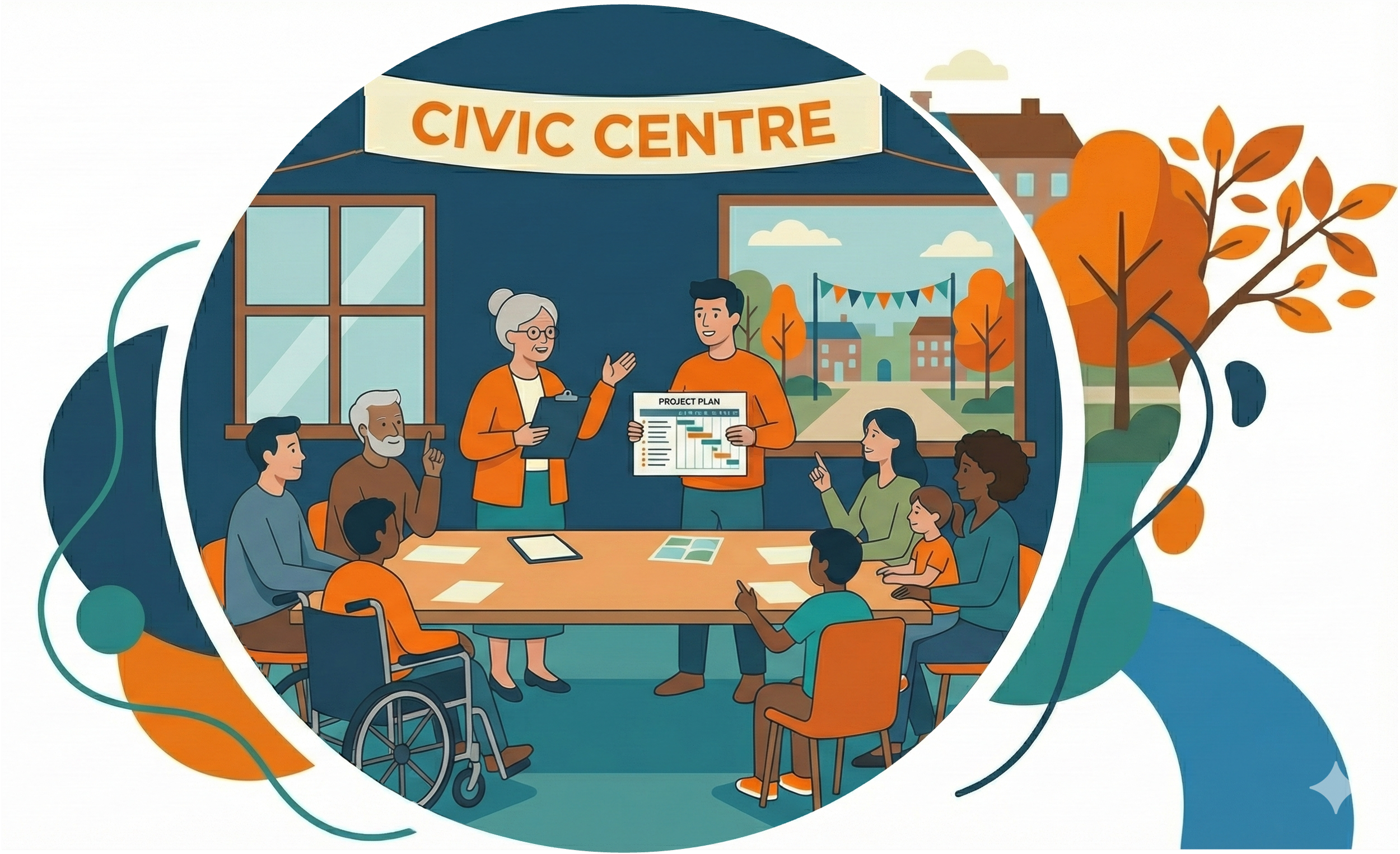
This all reflects closely with the work of Hilary Cottam, who has long argued that public systems designed around managing needs and delivering transactions systematically underinvest in relationships – despite acknowledgement that relationships are central to sustained, transformative change. In neighbourhood policy, this manifests as a persistent gap between recognising social conditions and funding the institutions that actually cultivate them.
This gap has been explored extensively in sustainability transitions, urban innovation and public sector innovation literature through the concept of transition intermediaries. These institutions – variously described as urban living labs, urban labs or urban observatories – operate in the “messy middle” between the central state and communities. Rather than delivering programmes, these intermediaries anchor missions in their spatial, social and institutional contexts, brokering relationships between experimental niches and established regimes while building civic capacity over time (See: A typology of intermediaries in sustainability transitions).
Importantly, this anchoring function operates across multiple system levels, working in-between actors, networks and institutions, compensating for the weak institutions capabilities within public systems themselves. While the literature varies in how intermediaries are defined – ranging from formal organisations to informal or hybrid arrangements, in a sense, they are fundamentally operating as social infrastructure institutions: durable, place-anchored “operating systems” that integrate functions fragmented by modern policy, steward relationships over time, and translate experimentation into routinised practice at the neighbourhood scale.
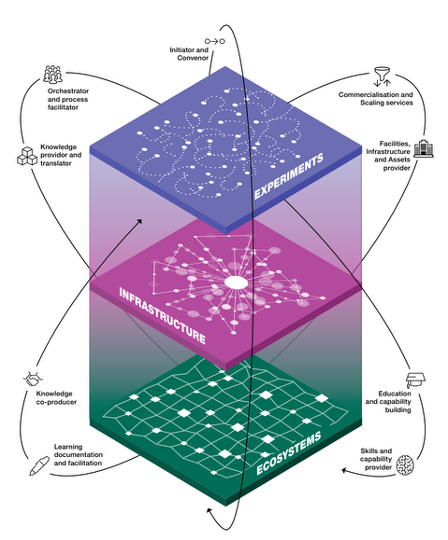
University Living Lab layers and roles
Source. Advancing University Living Labs. Relational Infrastructure for Transformative Impact. Monash University. 2025.
Monash University Advancing University Living Labs model offers a useful conceptual illustration of this institutional logic (through the lens of University Living Labs), defining social and relational infrastructure through a three-layer model:
Experiments: targeted, time-bound initiatives that respond to specific societal challenges and test specific approaches or solutions.
Infrastructure: relational, organisational and material systems that support cross-cutting research, education, operations, and engagement.
Ecosystems: place-based networks connecting the university with communities, government, and industry.
The model emphasises that individual projects only generate lasting impact when anchored in organisational capacity and embedded in wider relational systems – addressing societal challenges through orchestration, integration and connection.
“Experiments alone do not produce transformation”
When we start translating this to neighbourhood policy, the impacts are fairly straightforward. Experiments alone do not produce transformation. What matters is the presence of an institution capable of holding activity in place, integrating it into everyday social and economic life, and connecting it to wider systems of support and opportunity. Fundamentally, without that organisational and relational infrastructure, learning dissipates, coordination fragments, and impact decays.
Seen in this way, the central question for neighbourhood missions is not whether enough initiatives are being launched, but whether we are investing in the institutions capable of functioning as neighbourhood-scale operating systems.
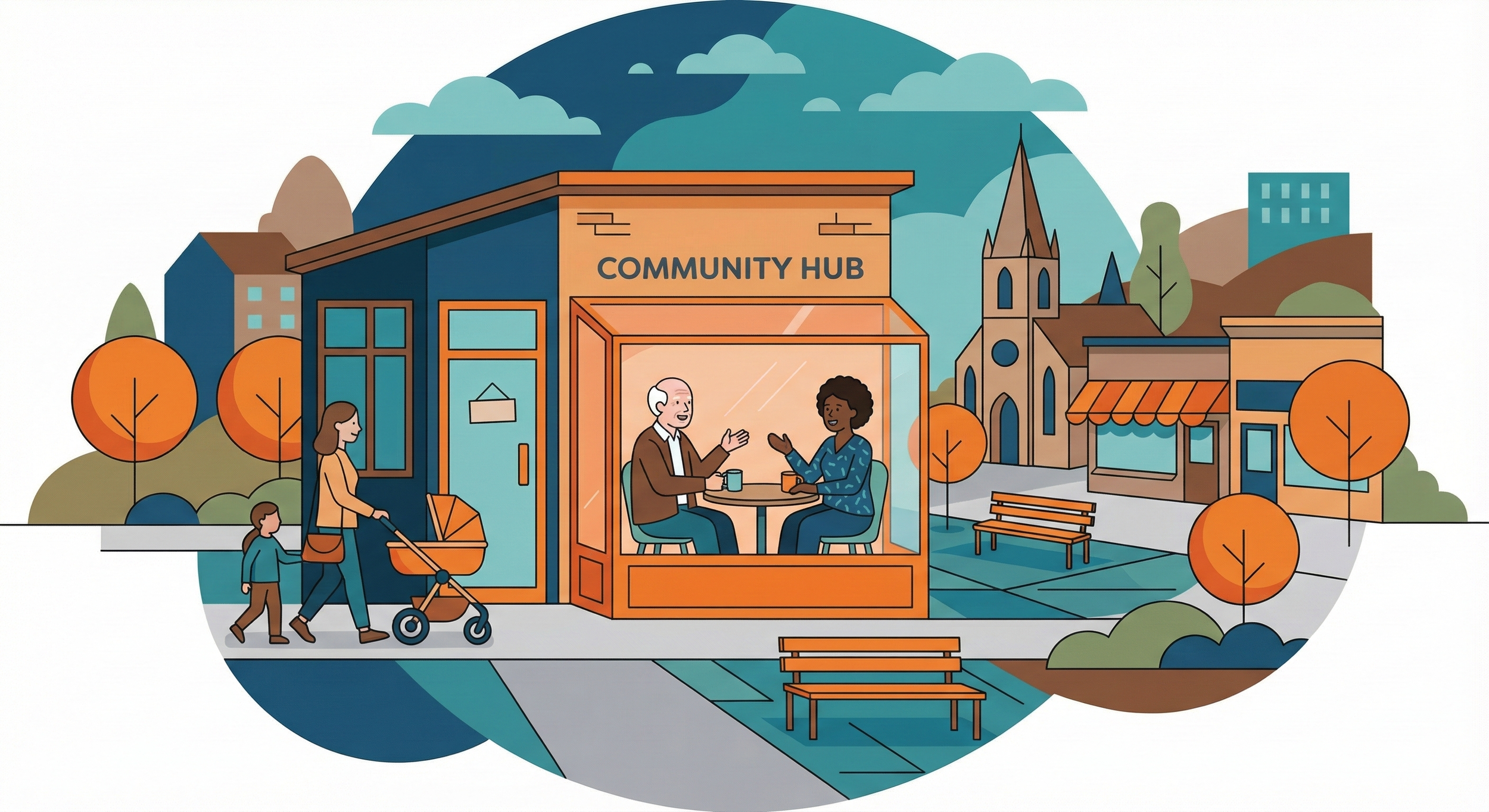
Citizen Hub: social infrastructure in practice
There is no shortage of genuinely wonderful high-profile work on social infrastructure institutions – from CIVICSQUARE’s Neighbourhood Doughnut to Dark Matter Labs’ Homes That Don’t Cost the Earth or even Regen Melbourne’s Earthshots – but for me, Citizen Hub in St Neots offers a quieter, and in many ways more instructive, example of how this institutional logic operates at neighbourhood scale. Describing itself as a social infrastructure company, Citizen Hub was not designed as a programme, pilot or service line, but as a place-anchored Community Interest Company capable of holding multiple forms of activity, relationship and support over time.
Located in a former Jobcentre in the centre of St Neots, Citizen Hub deliberately rejected the transactional logic that had previously governed the space. Rather than structuring encounters around short, compliance-driven interactions, it created the conditions for repeated, informal and relational engagement. People come to talk, have coffee, join sports clubs, access therapy, and discuss work in ways that are not pre-scripted or siloed. Employment support remains present, but it is embedded within a wider civic ecology that treats work, wellbeing and social connection as inseparable in practice.
What distinguishes Citizen Hub is not any single activity, but its institutional design that places public value as both a process and an outcome at its heart. It provides continuity where services are episodic, integration where policy is fragmented, and stewardship where programmes are time-limited. In doing so, it creates space for experimentation while ensuring that learning, trust and coordination accumulate rather than dissipate. Although Citizen Hub is not a university living lab in form or intent, it performs precisely the institutional function identified in the Monash framework: anchoring activity in organisational and relational infrastructure so that impact can compound over time.

What this means for neighbourhood policy
This all raises a harder question for neighbourhood policy. Citizen Hub’s impact does not stem from rapid replication or expansion, but from depth: long-term presence, dense relationships and sustained local legitimacy. When I had the privilege to interview Founder Alex Hughes and Co-Design Lead Lauren Dark over the summer, I was able to ask them about their thoughts of scaling the model. Both of them told me (with some emphasis) the importance of “going an inch wide and a mile deep” when co-producing with communities. This challenges the dominant assumption that scale must always mean reach. Some social infrastructure institutions may matter not because they scale widely, but because they scale deeply – embedding capability and resilience in place over time.
Taken together, these insights point to a clear policy implication. If neighbourhoods are to move from being passive recipients of mission-led interventions to active participants in growth and renewal, investment must shift toward social infrastructure as core economic and democratic infrastructure.
This does not mean abandoning jobs, skills or transport policy. It means changing the conditions under which these interventions are delivered. A recent briefing from Manchester Metropolitan University on Policy Priorities to Support Relational Public Services identifies three shifts required to make place-based approaches viable in practice:
Multi-year, preventative and place-flexible funding that supports stewardship rather than short-term programmes;
Regulatory and accountability frameworks that prioritise learning over compliance; and
Workforce and institutional designs that enable continuity, discretion and hybrid roles.
For neighbourhood missions, whether framed as transformation or renewal, the implication is straightforward. The question is no longer whether social infrastructure matters, but whether mission-oriented growth policy is willing to integrate these reforms into how neighbourhoods are funded, governed and supported, enabling them not just to connect to opportunity, but to shape it.
Expanding the resources for place-based renewal
At Recurve we equip place leaders and their partners to navigate change, foster resilient innovation ecosystems and drive enduring economic renewal. In a time of upheaval and uncertainty, Recurve is your partner for maximising the opportunity posed by Pride in Place and other local funding programmes.
As lead author of Mobilising the Impact Economy as Partners in National Renewal, the final report of the Social Impact Investing Advisory Group, we can help you to deepen the social infrastructure in your area, though collaboration with the impact economy.
Whether 1:1 or as part of a cohort of peers, we have built support packages to help you to understand the opportunity and act on it. Applications are opening soon for the inaugural Impact for Places Academy—a 12-month executive programme for leaders from established, emerging and aspiring strategic authorities and their partner organisations. Click below to receive the prospectus when it is published or visit our services page for more information.
You might also like…

Lessons from the medieval abbey for 21st century place leadership